
Diagram of the system for addressing climate change
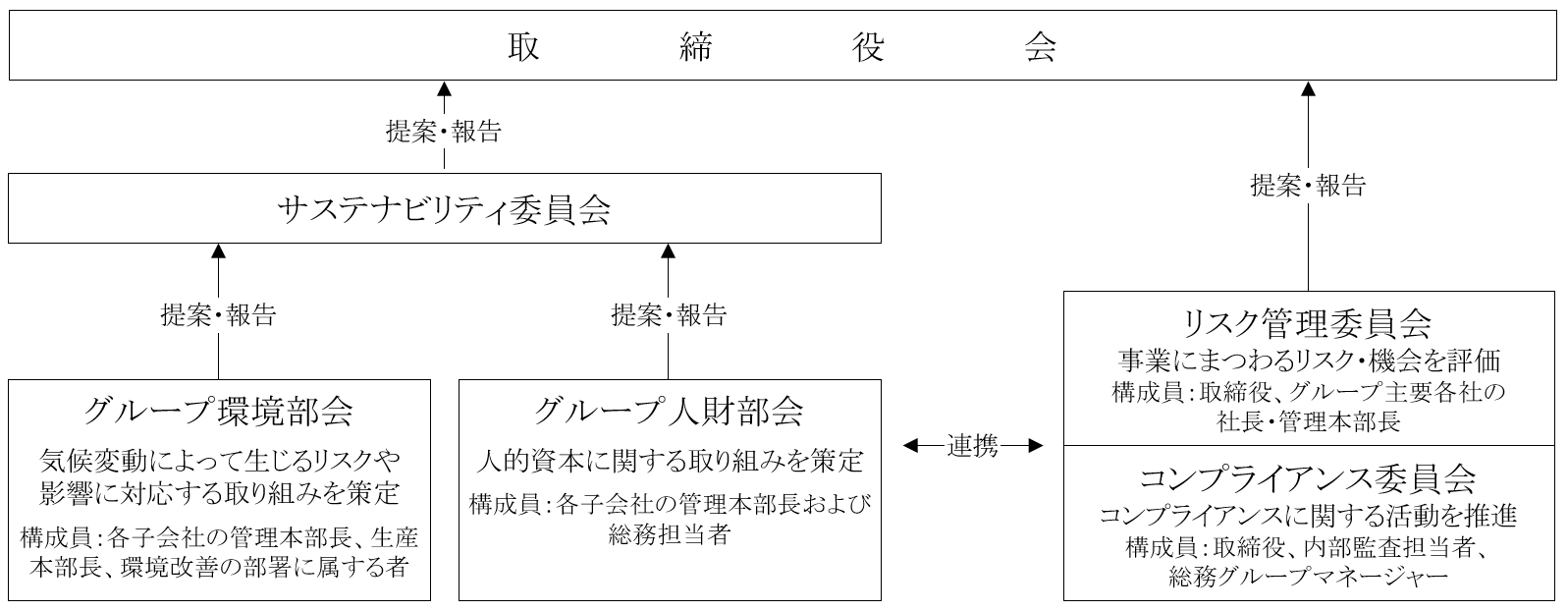
①Governance
Our Group recognizes the changes caused by climate change as a significant risk factor. To address the impacts of climate change, our Group has established a Group Environmental Subcommittee—overseeing by the Corporate Planning Group of Asseed Holdings Co., Ltd. and comprising the heads of the Management and Production Divisions at each major Group company—to implement initiatives, set targets, and report on progress toward those targets to the Sustainability Committee.
Translated with DeepL.com (free version)
②Strategy
Our group is drawing on the TCFD recommendations to identify the risks and opportunities that climate change poses to our business, and we are developing countermeasures for the following items, which we have extracted from two temperature scenarios: the 1.5°C scenario and the 4°C scenario.
Transition risks related to climate change
| Category | Impacts of Climate Change | Time axis | degree of influence | Countermeasures |
|---|---|---|---|---|
| Laws and Regulations / Policies | Costs are incurred for the company’s own emissions (Scope 1, 2). | Medium-term | Middle | (Vending machine operation retail business) ・Improving vending machine operation efficiency ・Making vehicles more energy efficient (hybrid, EV) (Beverage manufacturing business) ・Making manufacturing machinery and equipment more energy efficient |
| Laws and Regulations / Policies | In order to comply with stricter GHG emissions regulations, the cost of introducing renewable energy has increased. | Medium-term | Large | ・Promotion of energy conservation in manufacturing machinery and equipment ・Implementation of energy conservation activities in the office ・Restraint of cost increases through a review of power companies |
| Laws and Regulations / Policies | Increased costs due to replacing vehicles for vending machine management and introducing energy-saving equipment at factories. | Short-term | Large | Promoting the optimization of energy-saving investment periods |
| Market | If consumers become more environmentally conscious, their purchasing behavior will change, and profits will decline. | Short~ Medium-term | Middle | Calculation, disclosure and promotion of reduction of CFP |
| Market | Due to the rise in environmental awareness among consumers, the number of vending machines being removed is increasing, and the number of machines installed is decreasing. | Medium~ Long-term | Middle | ・Proposals for replacing vending machines with full-line vending machines and vending machines that can handle various product sizes ・Promoting the environmental performance of energy-saving vending machines |
| Evaluation | Decrease in investor confidence, increase in recruitment costs and financing costs from financial institutions | Medium-term | Middle | ・Ongoing disclosure of information to stakeholders ・Responding to external ratings related to climate change |
Physical risks related to climate change
| Category | Impacts of Climate Change | Time axis | degree of influence | Countermeasures |
|---|---|---|---|---|
| acute | Shortage of personnel in the event of an employee being affected by an increase in natural disasters | Short~Medium-term | Middle | ・Review of BCP and disaster prevention manuals |
| acute | Disruption of product procurement due to damage to beverage manufacturers | Short-term | Middle | ・Promotion of BCP measures in the supply chain ・Diversification of procurement routes |
| chronic | If the price of raw materials rises or it becomes necessary to switch to alternative raw materials, costs will increase. | Medium~ Long-term | Middle | ・Diversification of raw material procurement sources ・Review of sales prices |
| chronic | Due to global warming, the working environment for installing and managing vending machines has deteriorated, and operating costs have increased. | Medium~ Long-term | Middle | ・Implementation of a work style that avoids the peak summer temperatures by working flexible hours ・Improvement and review of the work environment |
Opportunities related to climate change
| Category | Impacts of Climate Change | Time axis | degree of influence | Countermeasures |
|---|---|---|---|---|
| Energy Source | The introduction and expansion of solar power generation and electricity storage technology has reduced the cost of purchasing electricity. | Short~Medium-term | Middle | ・Considering the introduction of in-house renewable energy generation |
| Market | If consumers become more aware of the need to stockpile against natural disasters and the market expands, the profits of products suitable for disaster prevention stockpiling will increase. | Short~Medium-term | Middle | ・Strengthen sales of products suitable for disaster stockpiling (emergency drinking water) |
| Market | Demand for beverages to prevent heatstroke is increasing, and profits from the vending machine operation retail business and beverage manufacturing business are increasing. | Medium~ Long-term | Large | ・Strengthen the production and sales of beverages to prevent heatstroke ・Develop a sales strategy for vending machines that matches the rise in average temperatures |
| Resilience | By promoting decarbonization initiatives, the company’s reputation among stakeholders has improved, and its share price has risen. | Short~Medium-term | Middle | ・Promotion of emission reductions in line with reduction targets |
(Definition of impact level)
・Large: Significant impact, measures are essential.
・Medium: Not a significant impact, but measures will be necessary in the future.
・Small: No particular measures or responses are necessary at this stage.
(Definition of time axis)
・Short term: Up to 3 years.
・Medium term: 3 to 10 years.
・Long term: 10 to 30 years.
③Risk Management
To promote group-wide risk management, our Group has established a Risk Management Committee composed of directors, representatives of major Group companies, and the heads of the Production and Administration Divisions. This committee conducts an annual review of the various risks and opportunities associated with our business operations. For each risk and opportunity, the committee assesses priority based on frequency of occurrence and impact, and reports its findings to the Board of Directors. This risk management framework also encompasses sustainability-related risks.
Translated with DeepL.com (free version)
④Indicators and Targets
To assess and manage the impact of climate-related issues on our business operations, our Group calculates greenhouse gas emissions (Scopes 1–3) in accordance with the GHG Protocol standards. We will continue to strive to improve the accuracy and granularity of our GHG emissions calculations.
In addition, we have set reduction targets for Scope 1 and 2 emissions of a 46% reduction by 2030 (compared to 2013) and Net Zero by 2050, and we are currently considering setting reduction targets for Scope 3 emissions.
Translated with DeepL.com (free version)
ASEED Group GHG emissions (t)
| 項目 | 2024.3 | 2025.3 | 2026.3 |
|---|---|---|---|
| Scope1 | 9,482 | 9,206 | 8,290 |
| Scope2 | 5,062 | 5,302 | 5,028 |
| Scope1+Scope2 | 14,544 | 14,508 | 13,318 |
| Scope3 | 151,579 | 157,887 | 173,904 |
| Scope1・2・3合計 | 166,124 | 172,395 | 187,222 |
<Scope1,2>
・Base year:2013
・Target for 2030:△46%
・Target for 2050:△100%
(Note)
The calculation results are derived based on certain assumptions and premises. Furthermore, they have not been verified or certified by an independent third party. In the future, the figures we track and disclose may be subject to change due to factors such as an expansion of the scope of calculation, improvements in accuracy and granularity, changes to the emission factors and emission intensity applied, and developments in discussions regarding the clarification of international standards for calculation methods.